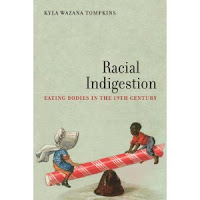
New Book: Racial Indigestion: Eating Bodies in the 19th Century

I’m sooo reading this: Racial Indigestion: Eating Bodies in the 19th Century – because it totally relates to my comments here.
The act of eating is both erotic and violent, as one wholly consumes the object being eaten. At the same time, eating performs a kind of vulnerability to the world, revealing a fundamental interdependence between the eater and that which exists outside her body. 


Racial Indigestion explores the links between food, visual and literary culture in the nineteenth-century United States to reveal how eating produces political subjects by justifying the social discourses that create bodily meaning.


Combing through a visually stunning and rare archive of children’s literature, architectural history, domestic manuals, dietetic tracts, novels and advertising, Racial Indigestion tells the story of the consolidation of nationalist mythologies of whiteness via the erotic politics of consumption. 


Less a history of commodities than a history of eating itself, the book seeks to understand how eating became a political act, linked to appetite, vice, virtue, race and class inequality and, finally, the queer pleasures and pitfalls of a burgeoning commodity culture. In so doing, Racial Indigestion sheds light on contemporary “foodie” culture’s vexed relationship to nativism, nationalism and race privilege.


Kyla Wazana Tompkins is an Associate Professor of English and Gender and Women’s Studies at Pomona College. She is a former journalist and restaurant critic.


For more, visit the author’s tumblr page: http://racialindigestion.tumblr.com 

Spread the love

More Articles for You

Basque, Portuguese & Noble Families of Puerto Rico: The European Roots You Didn’t Learn About

Explore how Basque, Portuguese, and noble European families shaped Puerto Rico’s southern towns (like Ponce) through surnames, migration paths, and hidden ancestral histories.

Spread the love

Puerto Rican Surnames with Taíno & African Roots: Origins in Ponce, Juana Díaz & the Southern Highlands

Many of the names we still see today (Montalvo, Negrón, Fontanes, Rivera, Chamorro, Zapata, Maldonado) carry the intertwined legacies of Taíno survivors, Africans and European migrants who moved through the island. This guide unravels those lineages with care.

Spread the love

I, Medusa by Ayana Gray: A Myth Retold with Power and Humanity

Ayana Gray’s I, Medusa reimagines the mythic villain as sister, priestess, survivor. Read Valerie M. Evans’ review of this bold, haunting retelling.

Spread the love

Brooklyn’s Jane Doe: A Shocking True Story of Assault, Media Betrayal, and Delayed Justice

Book review and critique by Valerie M. Evans: Brooklyn’s Jane Doe reveals how one woman’s assault became a public smear, and why her fight for justice still matters today.

Spread the love

Other Inheritances: Scent Memories from a Childhood at Fat’s Pet Shop in East Harlem

Before I ever knew what a perfumer was or that someone could make a living decoding and remixing scent, I …

Spread the love

Ghosts of the Palisades: Threads between memories, places and time

Somewhere tucked away, high on the Palisades, on lovely, dead end street, in the ether of the internet and Google …

Spread the love