 Literanista
June 25, 2026
Literanista
June 25, 2026
There are foods that are imprinted on our memory, before we can speak, before we understand the meaning of diaspora, illness, or inheritance. For me, one of those foods is porridge.
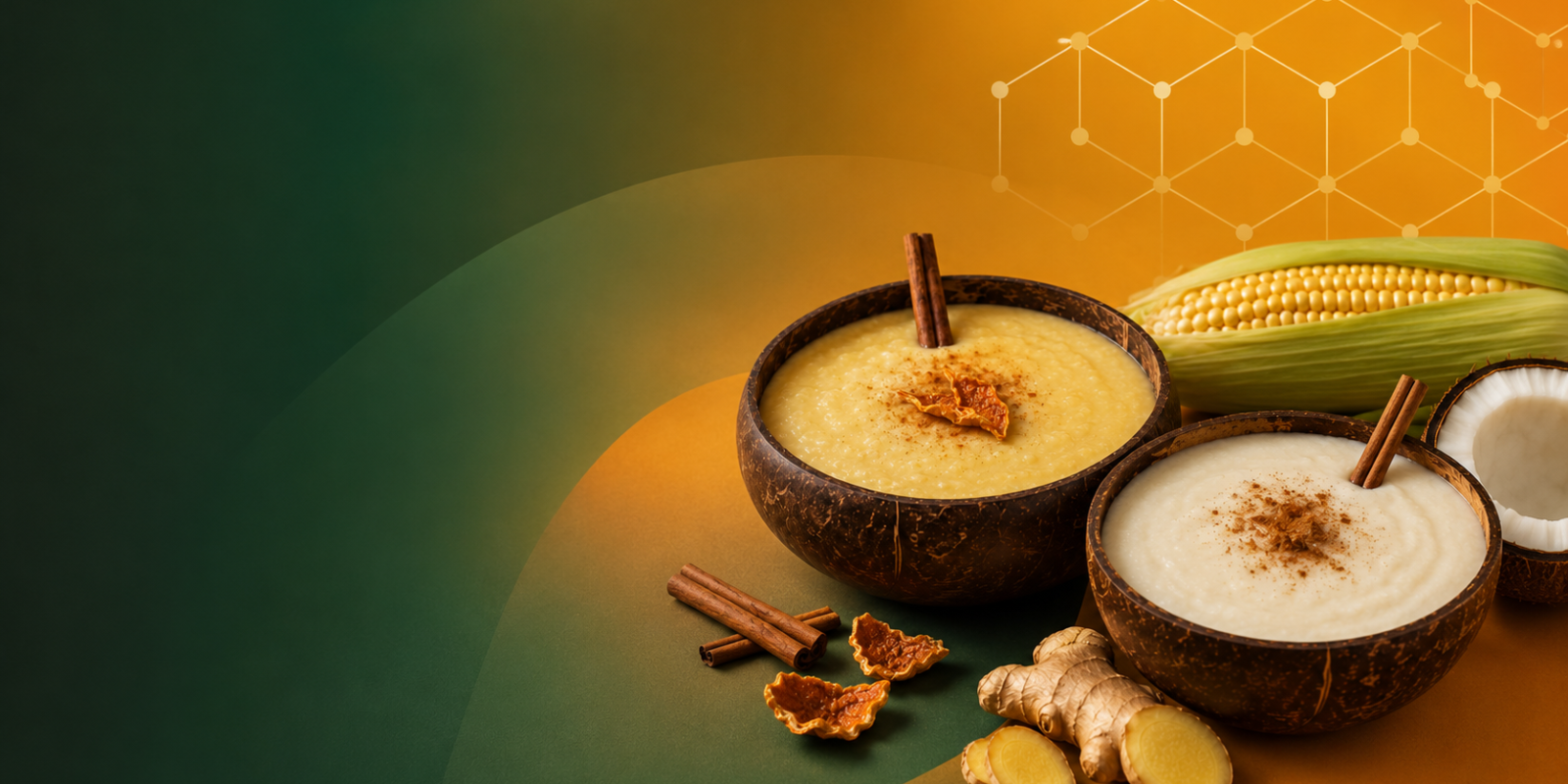
Not oatmeal in the American sense, although avena has its place in the Puerto Rican breakfast imagination. I mean the soft, steaming and fragrant porridges that came from the stove in small pots, stirred slowly, sweetened lightly, and scented with cinnamon, ginger, citrus, and milk courtesy of the Women, Infants, and Children program. Maizena so smooth, it was silky. Harina de maíz, thick and earthy, sucked through the hollow of a soft and chewy cinnamon stick. Breakfast as care work, as medicine, as a tired, disabled single mother standing over the stove, making something delicious out of barely anything.
Puerto Rican porridges live in the same subliminal peripheries of our identity as café con leche, pan sobao, arroz con dulce, farina, avena, and crema de maíz. They belong to the kitchen table, the sick day, the nuyorican who needs warmth, the elder who wants something easy, the mother who knows that sweetness does not have to be lavish.
They are also part of a much longer food story.
Puerto Rican foodways carry Indigenous Taíno, Spanish, African, Caribbean, and U.S. pantry influences, layered through colonization, survival, trade, migration, enslavement, adaptation, and family tradition. Corn, cassava, tropical fruits, root vegetables, coconut, plantains, rice, spices, sugar, milk, canned goods, coffee, and wheat-based pantry staples all tell different chapters of that story. Puerto Rican cuisine is never one pure thing. It is an archive of contact, loss, ingenuity, hunger, celebration, and return.
Porridge, especially, reveals how families make comfort from what is available.
A little cornstarch or cornmeal, a cup of milk, a single cinnamon stick or clove, a precious curl of dried orange rind saved in a jar, a wedge of fresh ginger sliced right off a small bareroot growing by the window. Sugar if you had it. Butter if you used it. Salt to brace the sweetness. These linger in the periphery of memory.
The Puerto Rican Porridge Family
Puerto Rican porridges are not a single recipe. They are a large family of warm breakfast cereals and spooned sweets, each with a different texture, history, and mood.
Maizena is made with cornstarch. It is pale, glossy, delicate, and smooth. It thickens quickly and needs a gentle hand. It is the one I think of as nursery food, sickbed food, and food a steadfast abuela brewed on the stove, although in my case, it was my mother who made it for me. When done well, maizena feels almost custard-like without being custard.
Harina de maíz or crema de maíz is made with fine cornmeal. It has more body and grain than maizena. It tastes more directly of corn, and depending on how finely ground the meal is, it can be creamy or rustic. It is cousin to polenta, but in a Puerto Rican kitchen it is usually sweet, milky, cinnamon-scented, and eaten for breakfast.
Avena is Puerto Rican oatmeal, often cooked with milk, cinnamon, vanilla, sugar, and sometimes evaporated milk. It can be simple or rich, depending on the family preference.
Farina is cream of wheat, a pantry staple in many Puerto Rican and Nuyorican homes, especially in the mid-to-late twentieth century. It is mild, quick, and deeply associated with weekday breakfast.
Arroz con leche and arroz con dulce are rice-based relatives, though they often live closer to dessert. Arroz con dulce, with coconut milk, spices, raisins, and ginger, shows how porridge can become ceremonial. My grandmother made colossal batches on holidays where we gathered at her home – all of her living children, spouses, children and somehow fed all of us. These foods do not sit neatly in one category. They are breakfast, dessert, remedy, memory, and cultural heritage.
My Mother’s Flavor: Cinnamon, Ginger, and Orange Rind
The flavor I remember most is not just corn or milk. It is the aroma that I can taste.
My mother made porridges with cinnamon sticks, pieces of fresh ginger, and dried orange rind. That combination changed everything. It brought brightness and heat into something soft. The cinnamon gave warmth. The ginger gave it a kick. The orange rind that I watched her carefully peel in one spiral and hang in our kitchen gave the whole pot a quiet scent that made our kitchen transcend place.
This is the part of cooking that recipes miss. They say “add cinnamon,” but they do not explain what happens when a cinnamon stick succumbs to the heat of the milk. “Use ginger,” no one explains that the ginger gives fire to the sweetness and “orange peel” is a tell for someone who knows the value of thinking ahead and repurposing what most consider waste. A small act that reminds of that oranges were once precious and prized artifacts from another continent, to be preserved and used sparingly by those with the understanding of what they had.
I want to save these memories but also share and preserve them so they live on and beyond our little tenement kitchen.
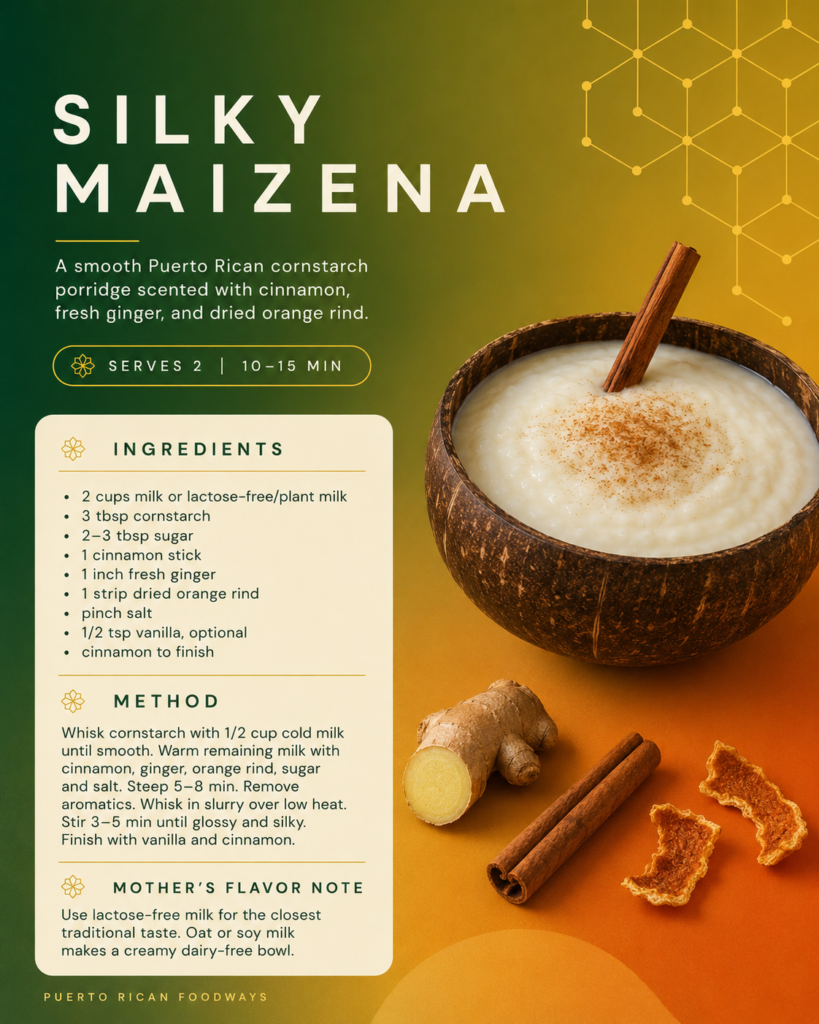
Recipe 1: Silky Puerto Rican Maizena with Cinnamon, Ginger, and Orange Rind
This version is smooth, fragrant, and gentle. It is ideal for breakfast, a light evening meal, or a comforting food when your stomach wants something simple.
Ingredients
Serves 2
- 2 cups milk, lactose-free milk, or unsweetened plant milk
- 3 tablespoons cornstarch
- 2 to 3 tablespoons sugar, maple syrup, or sweetener of choice
- 1 cinnamon stick
- 1 small piece fresh ginger, about 1 inch, peeled and sliced or lightly smashed
- 1 strip dried orange rind
- Pinch of salt
- 1/2 teaspoon vanilla extract, optional
- Ground cinnamon, for serving
Instructions
- In a small bowl, whisk the cornstarch with 1/2 cup of the cold milk until completely smooth. Do not skip this step. Cornstarch added directly to hot liquid will clump.
- In a small saucepan, combine the remaining 1 1/2 cups milk with the cinnamon stick, fresh ginger, dried orange rind, sugar, and pinch of salt.
- Warm over medium-low heat until the milk is steaming and fragrant, but not boiling. Let the cinnamon, ginger, and orange rind steep for 5 to 8 minutes.
- Remove the cinnamon stick, ginger, and orange rind, or leave the cinnamon stick in while cooking if you want a stronger flavor.
- Lower the heat. Slowly whisk in the cornstarch mixture.
- Stir constantly with a whisk or wooden spoon until the maizena thickens and turns glossy, about 3 to 5 minutes.
- Remove from heat and stir in vanilla, if using.
- Pour into bowls and dust with ground cinnamon.
Texture note
Maizena thickens more as it cools. For a thinner, pourable version, use 2 tablespoons cornstarch. For a spoonable, custard-like bowl, use 3 tablespoons.
Lactose-free and dairy-free options
- Closest traditional taste: lactose-free whole milk
- Creamiest plant-based option: oat milk or soy milk
- Higher protein option: fortified soy milk or pea milk
- Lightest option: almond milk
- More Caribbean flavor: light coconut milk mixed with water or another plant milk
If using coconut milk, use part coconut milk and part water or oat milk unless you want a very rich version.
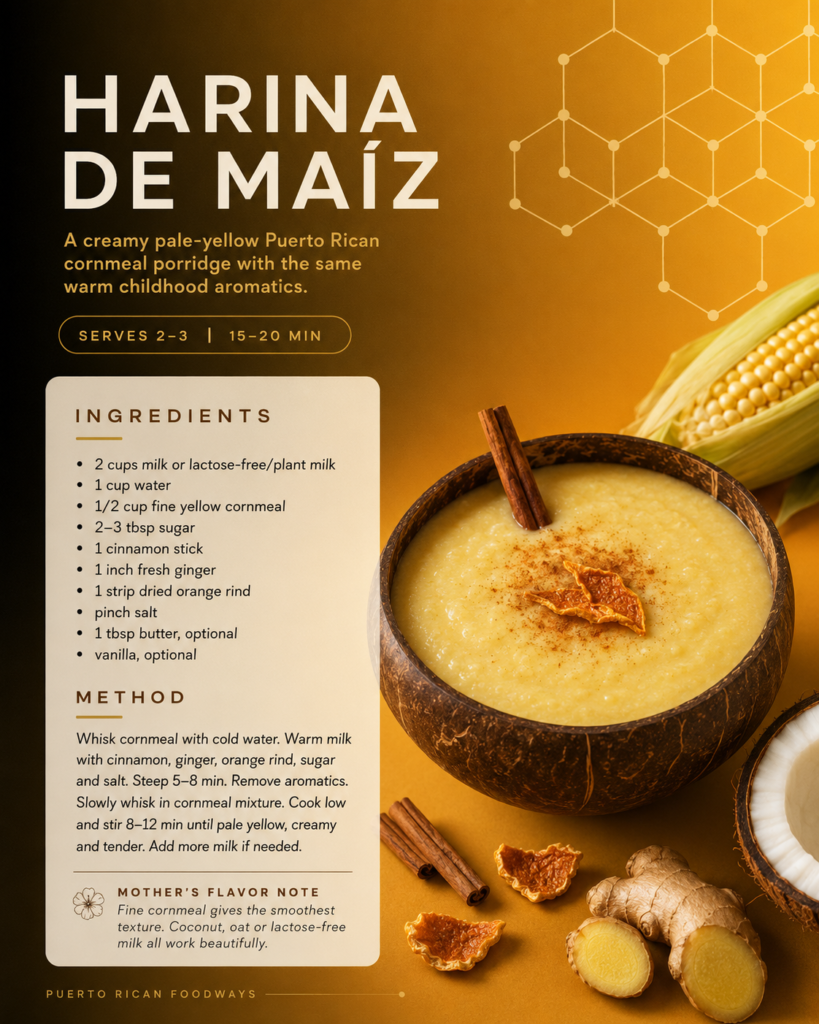
Recipe 2: Puerto Rican Harina de Maíz with Cinnamon, Ginger, and Orange Rind
This is heartier than maizena and has the earthy sweetness of corn. Use fine yellow cornmeal, if possible. Coarse cornmeal will work, but it needs more liquid and more time.
Ingredients
Serves 2 to 3
- 2 cups milk, lactose-free milk, or unsweetened plant milk
- 1 cup water
- 1/2 cup fine yellow cornmeal
- 2 to 3 tablespoons sugar, brown sugar, maple syrup, or sweetener of choice
- 1 cinnamon stick
- 1 small piece fresh ginger, peeled and sliced or lightly smashed
- 1 strip dried orange rind
- Pinch of salt
- 1 tablespoon butter or dairy-free butter, optional
- 1/2 teaspoon vanilla extract, optional
- Ground cinnamon, for serving
Instructions
- In a bowl, whisk the cornmeal with 1 cup cold water until smooth. This helps prevent lumps.
- In a saucepan, combine the milk, cinnamon stick, ginger, dried orange rind, sugar, and salt.
- Warm over medium-low heat until steaming. Let the spices and orange rind steep for 5 to 8 minutes.
- Remove the ginger and orange rind. Keep or remove the cinnamon stick, depending on how strong you want the flavor.
- Slowly whisk in the cornmeal mixture.
- Cook over low heat, stirring often, for 8 to 12 minutes, until creamy and tender. If it becomes too thick before the cornmeal softens, add more milk or water, a few tablespoons at a time.
- Stir in butter and vanilla, if using.
- Serve warm with ground cinnamon.
Texture note
Fine cornmeal makes a smoother harina de maíz. If your cornmeal is coarse, cook it longer and use extra liquid. The final texture should be creamy, not stiff.
Avena: The Go-to Porridge of the Puerto Rican Home
Avena is Puerto Rican oatmeal, but that description does not do enough. In many Boricua and Nuyorican kitchens, avena was not just oats boiled in milk. It was milk infused first with cinnamon, sometimes ginger, sometimes citrus peel, sometimes vanilla, then stirred slowly with oats until the pot became creamy and fragrant. It was practical, affordable, filling, and endlessly adaptable.
Avena belongs to the weekday early morning, the before-school bowl, the recovering stomach, the grandmother’s kitchen, the mother trying to get something warm into a child before the day begins. It is not as delicate as maizena or as corn-rich as harina de maíz, but it sits beside them in the same family of comfort foods: warm cereal as care, spice as memory, milk as softness, sweetness as a small kindness.
In Puerto Rican homes, avena also reveals how foodways change through the pantry. Oats are not Indigenous to the Caribbean, but Puerto Rican cooking has always absorbed, adapted, and made ingredients familiar. Avena was claimed through repetition: through cinnamon sticks in the pot, evaporated milk or fresh milk, through the hand that stirred, through the child who came to recognize that smell and coffee brewing as the signal to wake up and face the day.
For lactose-intolerant families, avena may be one of the easiest porridges to adapt. Lactose-free milk gives it the most familiar flavor, while oat milk deepens its natural creaminess. Soy milk adds body and protein. Coconut milk gives it a more Caribbean richness, especially when paired with cinnamon, ginger, and orange rind.
Like the others, avena is more about attention. Warm the milk first. Let the cinnamon and ginger open. Give the oats time to soften. Stir until the texture feels generous.
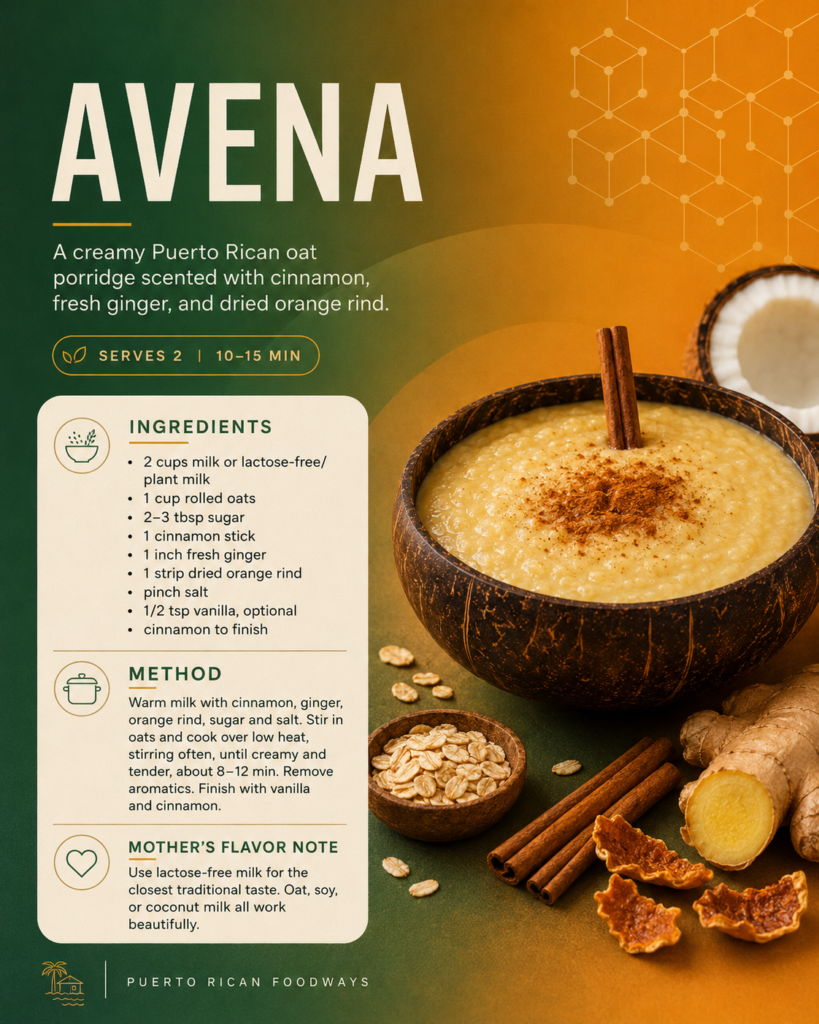
Puerto Rican Avena with Cinnamon, Ginger, and Dried Orange Rind
Serves: 2
Time: 10 to 15 minutes
Ingredients
- 2 cups milk, lactose-free milk, or unsweetened plant milk
- 1 cup rolled oats
- 2 to 3 tablespoons sugar, brown sugar, maple syrup, or sweetener of choice
- 1 cinnamon stick
- 1 small piece fresh ginger, about 1 inch, peeled and sliced or lightly smashed
- 1 strip dried orange rind
- Pinch of salt
- 1/2 teaspoon vanilla extract, optional
- Ground cinnamon, for serving
Instructions
- In a small saucepan, combine the milk, cinnamon stick, fresh ginger, dried orange rind, sugar, and salt.
- Warm over medium-low heat until the milk is steaming and fragrant, but not boiling. Let the cinnamon, ginger, and orange rind steep for 5 minutes.
- Stir in the rolled oats.
- Cook over low heat, stirring often, until the oats soften and the mixture becomes creamy, about 8 to 12 minutes.
- Remove the cinnamon stick, ginger, and orange rind.
- Stir in vanilla, if using.
- Serve warm with a dusting of ground cinnamon.
Texture note
For a looser avena, add a splash more milk near the end. For a thicker, spoonable bowl, cook 2 to 3 minutes longer. Quick oats will make a softer, more uniform porridge; rolled oats give more texture.
Lactose-free and dairy-free options
- Closest traditional taste: lactose-free milk
- Creamiest dairy-free version: oat milk
- Higher protein option: fortified soy milk
- More Caribbean flavor: light coconut milk blended with water or oat milk
- Milder option: almond milk
For the version that tastes most like a childhood kitchen, use lactose-free whole milk or oat milk with cinnamon, ginger, orange rind, and vanilla.
The Lactose Issue in Puerto Rican Kitchens
Many Puerto Ricans have a complicated relationship with milk. I, personally, have been repulsed by it as long as I could remember and had to doctor it heavily with chocolate to be able to keep it down.
Milk seems so central to many comfort foods: café con leche, avena, maizena, flan, tembleque, arroz con dulce, tres leches, batidas, and breakfast cereals. On the other hand, many of us grew up in families where people quietly had stomach pain, bloating, gas, urgency, or “bad digestion” after dairy without necessarily recognizing it as lactose intolerance.
Lactose intolerance happens when the body does not make enough lactase, the enzyme needed to digest lactose, the sugar found in milk. It is not rare. It is especially common in many populations outside Northern European ancestry, including Latino communities. So many “traditional” recipes as we received them in the twentieth century call for fresh milk, evaporated milk, condensed milk, or canned dairy but adapting a recipe does not make it less Puerto Rican.
Puerto Rican cooking has always adapted. It adapted across Indigenous foodways, Spanish colonization, African survival, Caribbean exchange, U.S. imports, migration to New York, and the economics of whatever was in the cabinet. As my pediatrician always reminded me when my son was an infant, fed is best.
Best Milk Switches for Puerto Rican Porridges
For maizena, texture is the most important factor. You want something that thickens smoothly and does not separate.
Good options:
- Lactose-free milk
- Fortified soy milk
- Oat milk
- Almond milk
- Coconut milk diluted with water or another plant milk
- Pea milk
For harina de maíz, flavor and body are more important.
Good options:
- Lactose-free whole milk
- Oat milk
- Soy milk
- Coconut milk blend
- Evaporated coconut milk, used sparingly
- Almond milk with a spoonful of coconut cream for richness
For the most traditional taste without lactose, lactose-free dairy milk is the easiest switch. For a fully dairy-free version, fortified soy milk is usually the most nutritionally comparable to dairy milk, while oat milk gives a soft, familiar creaminess.
Choose unsweetened milk if you want to control the sugar. Many plant milks are already sweetened or flavored, which can make a simple porridge taste artificial.
Flavor Variations
Once you know the basic method, Puerto Rican porridge becomes a boilerplate for other versions.
Try:
- Cinnamon stick and lime peel
- Ginger and star anise
- Orange rind and vanilla
- Coconut milk and nutmeg
- Clove and cinnamon
- Brown sugar instead of white sugar
- Maple syrup for a deeper sweetness
- Pumpkin Pie spice for a touch of nutmeg
- A pinch of cardamom for a diasporic twist
You can also top harina de maíz with:
- Butter or dairy-free butter
- Ground cinnamon
- Toasted coconut
- Banana slices
- Guava paste pieces
- A drizzle of honey
- Toasted sesame seeds
- Crushed walnuts or almonds, if tolerated
Maizena, to me, wants less. Its beauty is in its smoothness.
Food as Archive
I think often about how much family history is held in recipes that no one wrote down.
A grandmother’s sofrito. A mother’s arroz con pollo. The exact way someone rinsed rice. What unit of measurement “un chin” equals. The brand of cornmeal she trusted. The well seasoned pot she preferred. The way she knew, without measuring, when maizena had turned from milk to silk.
For Puerto Ricans in the diaspora, especially those of us shaped by New York, migration, Spanglish, public school lunches, botanicas, bodegas, Catholic candles, plastic-covered sofas, and continuous flights back to the island, food is often the first archival storehouse we are given.
Before any discourse on what Taíno, African, Spanish, Boricua, Nuyorican, diaspora, survival mean, we know innately that cinnamon and orange peel in milk means somebody loved us enough to feed us. These porridges are ordinary and ancestral at the same time.
They remind me that some inheritances arrive warm, in a bowl, with cinnamon on top.
Community
Do you remember maizena, harina de maíz, avena, or farina from your childhood kitchen? Did your family make it with evaporated milk, fresh milk, coconut milk, cinnamon, ginger, vanilla, orange peel, or lime peel?
I would love to hear how your mother, grandmother, titi, or abuelo made it, especially if your family adapted it for lactose intolerance, diabetes, gluten-free needs, or dairy-free cooking.
Puerto Rican foodways live because we keep telling the stories and sharing the methods. A recipe is only one part, memories are the rest.
FAQ
What is maizena?
Maizena is a Puerto Rican-style cornstarch porridge, usually cooked with milk, sugar, cinnamon, and vanilla until smooth and silky.
What is harina de maíz?
Harina de maíz is a warm Puerto Rican cornmeal porridge, also called crema de maíz, often served for breakfast with cinnamon and milk.
Can Puerto Rican maizena be made lactose-free?
Yes. Lactose-free milk gives the closest traditional taste. Fortified soy milk, oat milk, almond milk, coconut milk blends, and pea milk can also work.
What spices go in Puerto Rican porridge?
Common flavors include cinnamon, vanilla, nutmeg, ginger, orange peel, lime peel, clove, and sometimes coconut.
Sources / Further Reading
NIDDK. “Definition & Facts for Lactose Intolerance.” National Institute of Diabetes and Digestive and Kidney Diseases.
https://www.niddk.nih.gov/health-information/digestive-diseases/lactose-intolerance/definition-facts
U.S. Food & Drug Administration. “Milk and Plant-Based Milk Alternatives: Know the Nutrient Difference.” FDA.
https://www.fda.gov/consumers/consumer-updates/milk-and-plant-based-milk-alternatives-know-nutrient-difference
Suchy, Frederick J., Elizabeth Brannon, Teresa Carpenter, Jose Fernandez, Rick Gilsanz, Kathleen Gould, Ruth Hall, et al. “NIH Consensus Development Conference Statement: Lactose Intolerance and Health.” Annals of Internal Medicine / PubMed Central.
https://pmc.ncbi.nlm.nih.gov/articles/PMC1906652/
Familia Kitchen. “A Very Brief History of Puerto Rican Cuisine.” Familia Kitchen.
https://familiakitchen.com/a-very-brief-history-of-puerto-rican-cuisine/
Condé Nast Traveler. “The Farm-to-Fork Movement in Puerto Rico Is in Full Swing.” Condé Nast Traveler.
https://www.cntraveler.com/story/the-farm-to-fork-movement-in-puerto-rico-is-in-full-swing