 Literanista
April 16, 2026
Literanista
April 16, 2026
Puerto Rico is often noted for its resilience, but “resilience” can be a dangerous word. It can turn endurance into virtue, suffering into martyr narrative, and flatter the oppresed while excusing the system that has drained them. In the case of Puerto Rico, resilience is too often the language used to describe a people forced to survive conditions produced not by fate alone, but by a long colonial order that has normalized extraction, erasure, and sacrifice (Torres, 2025; Muñiz González, 2025).
To write honestly about Puerto Rico is not simply to write about hurricanes, debt, blackouts, lack of infrastructure or migration. It is to write about repetition. The same archipelago is asked, again and again, to absorb what others refuse to carry: empire, austerity, military occupation, environmental risk, racial denial, and political humiliation. It’s great to see that researchers have started to name this more directly. Aileen Torres reads Puerto Rico’s colonial history through a historical trauma lens, tracing the psychological consequences of repression, sterilization campaigns, surveillance, and state violence. John R. Muñiz González similarly argues that Puerto Rico’s postcolonial condition can be understood as collective trauma, a social and psychic condition produced by unresolved colonial domination rather than by isolated events alone (Torres, 2025; Muñiz González, 2025).
That framing matters because it moves us away from the lazy fiction that Puerto Rico’s suffering is episodic. Hurricane María was not only a natural disaster. It was a revelation of infrastructure shaped by colonial neglect, debt, and disposability. Scholars such as Catalina M. de Onís and Gustavo A. García López have argued that Puerto Rico’s disasters must be read through colonial power, not outside it. María did not create vulnerability from scratch. It illuminated a political arrangement in which Puerto Rico is routinely managed as useful, peripheral, and expendable (de Onís, 2018; García López, 2020).
Puerto Rico’s trauma is not only economic or administrative. It is also cultural and historical. It lives in the stories the people have been taught to tell about their own existence, and in what those stories leave out. One of the most enduring violences in Puerto Rican identity has been the systematic thinning out of Indigenous and African presence. Isar P. Godreau and her coauthors showed how school narratives in Puerto Rico minimized slavery, diminished anti-Black violence, and reinforced blanqueamiento as a social ideal. In that account, Blackness is made foundational enough to be used, but not central enough to be honored (Godreau et al., 2008).
The same thing has happened with Indigenous ancestry. Puerto Ricans have long been taught that the Taíno vanished, as if extinction were a neutral fact rather than a colonial convenience. Tony Castanha’s work challenges that myth directly, arguing for Indigenous continuity and reclamation in Borikén. Kristine M. Harrison similarly examines how schooling in Puerto Rico has participated in shaping identity through imperial frameworks that push Indigenous presence into a sealed past rather than a living inheritance (Castanha, 2011; Harrison, 2016). This is not just a matter of heritage. It is a matter of how a people are taught to misrecognize themselves (Castanha, 2011; Harrison, 2016).
So much of Puerto Rican identity has been managed through contradiction: celebrate the jíbaro, but deny the Indigenous. Praise mixture, but mute Blackness. Romanticize culture, but steamroll the history that produced it. The result is a national self-image too often built on curated forgetting. We are invited to inherit symbols while being estranged from the violence beneath them. That estrangement has consequences. It shapes self-worth, belonging, and the terms on which Puerto Ricans are allowed to imagine themselves. Godreau’s work makes clear that racial erasure is not accidental. It is taught, repeated, and absorbed (Godreau et al., 2008).
Those fractures do not end across the sea. Nuyorican identity has long carried the burden of colonial dislocation in public view. Jorge Duany’s work on Puerto Rico as a “nation on the move” remains one of the clearest frameworks for understanding the island and diaspora as part of a single unstable national formation. Edna Acosta-Belén’s work on Nuyorican literature shows that diaspora writing was never a lesser, diluted version of Puerto Rican culture. It was, and is, a site of cultural revitalization, critique, and invention under pressure (Duany, 2000; Acosta-Belén, 1992).
Nuyoricans have so often been made to occupy an impossible position: Not Puerto Rican enough for the island, not American enough for the mainland, too Spanish in one room, too English in another, too Black, too mixed, too urban, too “inauthentic,” too much of aftermath made visible. This is not simply an identity issue but a colonial condition. Puerto Ricans in the diaspora are often asked to prove their legitimacy in ways that mirror the island’s own unresolved status. The wound is not that identity changes. Identity always changes. The wound is that colonialism fractures belonging and then punishes the fractured for failing to appear whole (Duany, 2000; Acosta-Belén, 1992).
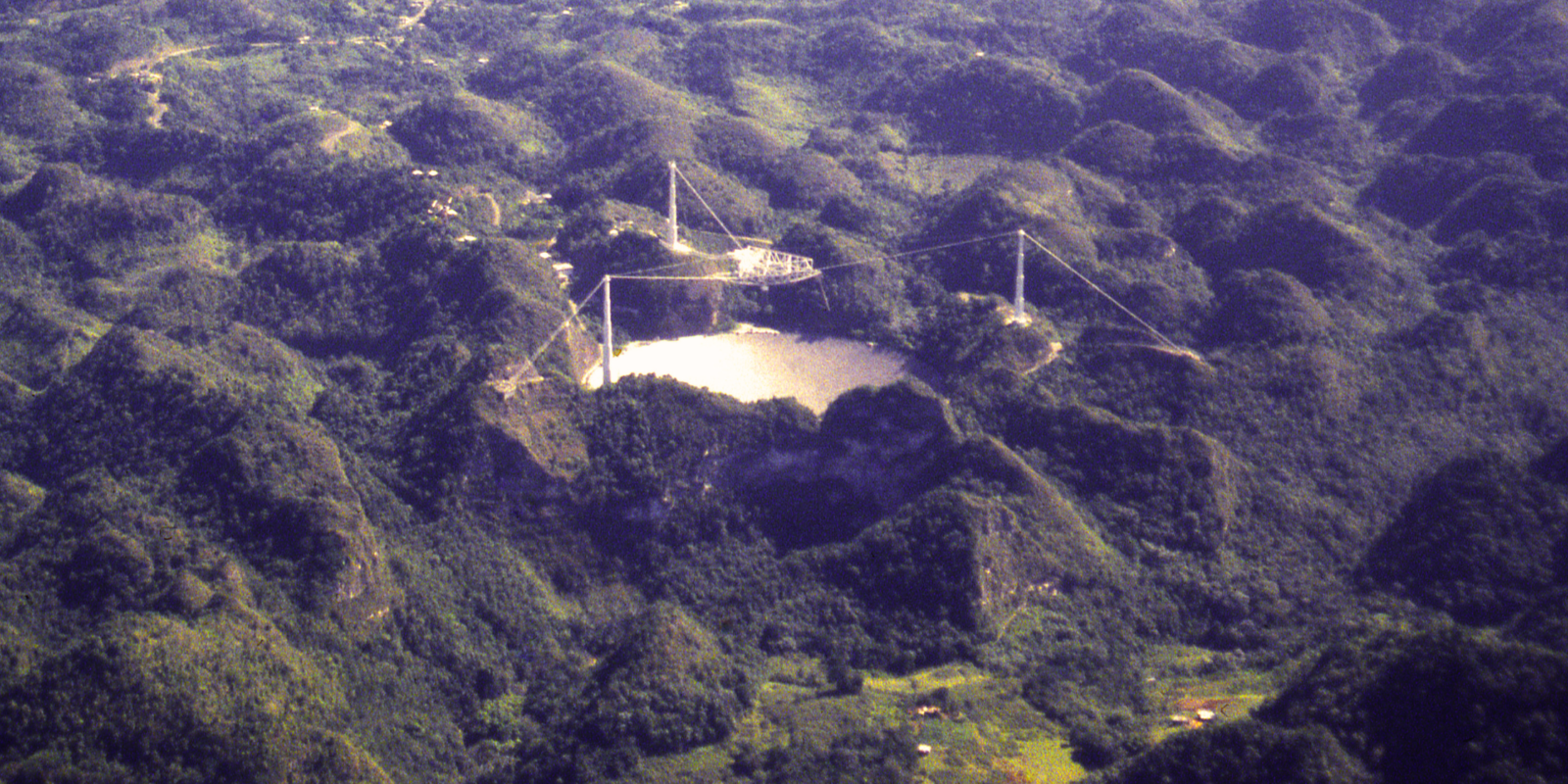
Seen through that lens, as we collectively dream once again of space travel, the loss of the Arecibo Observatory was never only about science. Of course, it mattered scientifically but it also mattered symbolically. It stood as one of the most iconic structures in Puerto Rico, a site of knowledge, wonder, and interstellar imagination. Its collapse felt larger than infrastructure failure. It felt like another entry in the long record of institutions on the island allowed to decay under the logic of deferred care. Nature described Arecibo as an icon, and that word is correct, but perhaps not complete enough. For many Puerto Ricans, Arecibo was not merely an icon. It was proof that the Puerto Rico could hold brilliance at world scale, and proof, too, of how easily brilliance can be abandoned when it belongs to a colony (Oza, 2023).
Arecibo belongs to a wider pattern of sacrificial loss. Vieques is perhaps the clearest example: a small Puerto Rican island treated for decades as a military target zone, its people expected to live with contamination, bombing, and the slow violence of being deemed strategically expendable. Researchers have described Vieques in terms of environmental inequity and military colonialism, and those terms matter because they refuse the lie that these harms were incidental (Yelin and Miller, 2009; Epting, 2015). Puerto Rico has repeatedly been asked to host the burden, absorb the damage, and bury the cost.
This is why I resist the easy rhetoric of resilience. Resilience is often what power praises when repair is politically inconvenient. It is what oppressors say when it wants the beauty of survival without the obligation of justice. Puerto Rico does not need more admiration for how much it can take. It needs a language equal to what has been taken from it: land, autonomy, archives, health, infrastructure, certainty, and the right to narrate itself without colonial distortion (Torres, 2025; Muñiz González, 2025).
What remains, then, is memory. The memory of Taíno continuity despite the extinction myth. The memory of African inheritance despite whitening and curricular evasion. The memory of Nuyorican life as an expression of Puerto Rican survival, not a deviation from it. The memory of Arecibo, Vieques, María, and every other so-called isolated event that was not isolated at all. Puerto Rico is not a case study in resilience. It is a record of what colonial modernity demands from the people it refuses to free. To call that resilience and stop there is not admiration. It is evasion.
References
Acosta-Belén, E. (1992) ‘Beyond Island Boundaries: Ethnicity, Gender, and Cultural Revitalization in Nuyorican Literature’, Callaloo, 15(4), pp. 979–998.
Castanha, T. (2011) The Myth of Indigenous Caribbean Extinction: Continuity and Reclamation in Borikén (Puerto Rico). New York: Palgrave Macmillan.
de Onís, C.M. (2018) ‘Energy Colonialism Powers the Ongoing Unnatural Disaster in Puerto Rico’, Frontiers in Communication, 3, article 2.
Duany, J. (2000) ‘Nation on the Move: The Construction of Cultural Identities in Puerto Rico and the Diaspora’, American Ethnologist, 27(1), pp. 5–30.
Epting, S.R. (2015) ‘The Limits of Environmental Remediation Protocols for Environmental Justice Cases: Lessons from Vieques, Puerto Rico’, Contemporary Justice Review, 18(3), pp. 352–365.
García López, G.A. (2020) ‘Reflections on Disaster Colonialism: Response to Yarimar Bonilla’s “The Wait of Disaster”’, Political Geography, 78, article 102170.
Godreau, I.P., Reyes Cruz, M., Franco Ortiz, M. and Cuadrado, S. (2008) ‘The Lessons of Slavery: Discourses of Slavery, Mestizaje, and Blanqueamiento in an Elementary School in Puerto Rico’, American Ethnologist, 35(1), pp. 115–135.
Harrison, K.M. (2016) Educational Imperialism: Schooling and Indigenous Identity in Borikén, Puerto Rico. Deep University Press.
Muñiz González, J.R. (2025) ‘Collective Trauma in Puerto Rico’s Postcolonial Condition’, Psychoanalytic Review, 112(4).
Oza, A. (2023) ‘Closing down an icon: will Arecibo Observatory ever do science again?’, Nature, 11 August.
Torres, A. (2025) ‘Trauma, Repression, and Resistance: A Critical Psychological Lens on Puerto Rico’s Colonial Past’, Revista Interamericana de Psicología / Interamerican Journal of Psychology, 59, e2282.