 Literanista
April 18, 2026
Literanista
April 18, 2026
I have been seeing a lot of requests for feminist rage books lately, and I understand why.
We are living through a cultural moment that has left many women furious, tired, sharpened, and newly unwilling to confuse silence with peace. In recent days, public outrage has intensified around reporting on a global online network described by lawmakers and commentators as an “online rape academy,” following a CNN investigation into private groups where men allegedly encouraged sexual abuse and shared material documenting it. At the same time, wider public conversation has been saturated with debates about misogyny, violence, consent, and what it means to raise boys into men who can read power, not simply inhabit it. Claims circulating online have also distorted parts of that reporting, which Snopes has since clarified.
In moments like this, people often ask for “feminist rage books.” I get the impulse. But what many of us are looking for is not rage alone. We are looking for language, history, structure, and a deeper political education. We want books that help us name what we are seeing, teach what has been erased, and raise more discerning readers with stronger moral and cultural judgment.
That is why I put together this list:
Feminist Theory Beyond the Basics: Primers, Canons, and Global Frameworks
I spent years in publishing curating, positioning, and promoting books, and this summer reading list is very much in that spirit. It begins with strong feminist primers, then moves into Black feminist thought, Indigenous feminist critique, Caribbean writing, African and Arab feminist analysis, Asian and postcolonial frameworks, and decolonial work that asks more of the reader than simple agreement.
If you are new to feminist theory, start with books that build vocabulary and orientation. bell hooks’ Feminism Is for Everybody remains one of the clearest entry points because it explains feminist politics without flattening them. Kimberlé Crenshaw’s work on intersectionality helps readers understand why gender can never be read apart from race, class, law, and power. Angela Davis, Audre Lorde, and Patricia Hill Collins deepen that foundation by making clear that feminism without history, labor, anti-racism, and structural critique is not serious enough for the world we are actually living in.
If you are trying to raise sons, or teach young people, or rebuild your own intellectual grounding, I would go further. Read Gloria Anzaldúa, Chandra Talpade Mohanty, Linda Tuhiwai Smith, Sylvia Wynter, and Audra Simpson. Read beyond the narrow, familiar syllabus. Read books that reveal how oppression, colonialism, racial hierarchy, nation, sexuality, and dispossession shape what gets called normal. Read books that make it harder to raise children on sentiment alone.
Because that is part of what is at stake now. Not simply whether women are angry, but whether we are willing to form readers who can identify domination before it becomes ordinary. Whether we are willing to teach boys that empathy is not enough without analysis. Whether we are willing to admit that culture is instructional. It teaches permission. It teaches hierarchy. It teaches who is believed, who is usable, and who is expected to absorb harm.
The best feminist theory books do not just validate feeling. They sharpen discernment. They make readers more historically literate, less easily manipulated, and more capable of recognizing the old architecture of power when it reappears in modern clothes.
So yes, if you are looking for feminist rage books, I’ve got you. This is what I do and have done for the past twenty years. This is also a list for anyone trying to build something more durable than outrage: a reading practice that widens imagination, strengthens judgment, and helps raise readers who are harder to fool.
Browse the list below:
Feminist Theory Beyond the Basics: Primers, Canons, and Global Frameworks
I organized this list to move from strong feminist primers into deeper work across Black feminist theory, women of color feminism, Indigenous thought, Caribbean writing, African and Arab feminist analysis, and transnational and decolonial critique. The aim is not a closed canon, but a sharper reading path for anyone trying to raise more discerning readers, stronger thinkers, and wider imaginations.
Primers and Foundational Texts
-
bell hooks, Feminism Is for Everybody
A clear, accessible introduction to feminist politics that makes the case for feminism as a transformative social ethic, not a niche academic project. -
Introduction to Women’s, Gender, and Sexuality Studies
A broad classroom-friendly overview of the field, useful for readers who want grounding in key terms, debates, and historical frameworks. -
Kimberlé Crenshaw, On Intersectionality: Essential Writings
A foundational collection from the scholar who helped name intersectionality, essential for understanding how power works across race, gender, class, and law. -
Simone de Beauvoir, The Second Sex
One of the most influential works in feminist thought, examining how womanhood is socially produced and historically constrained.
Black Feminist and Women of Color Feminist Theory
-
Angela Davis, Women, Race & Class
A classic study of abolition, labor, suffrage, and Black women’s political thought that refuses to separate feminism from race and class struggle. -
Audre Lorde, Sister Outsider
A vital essay collection on difference, anger, language, survival, and power from one of the sharpest feminist writers of the twentieth century. -
Patricia Hill Collins, Black Feminist Thought
A major theoretical work that maps Black women’s knowledge traditions and shows how domination is structured and resisted. -
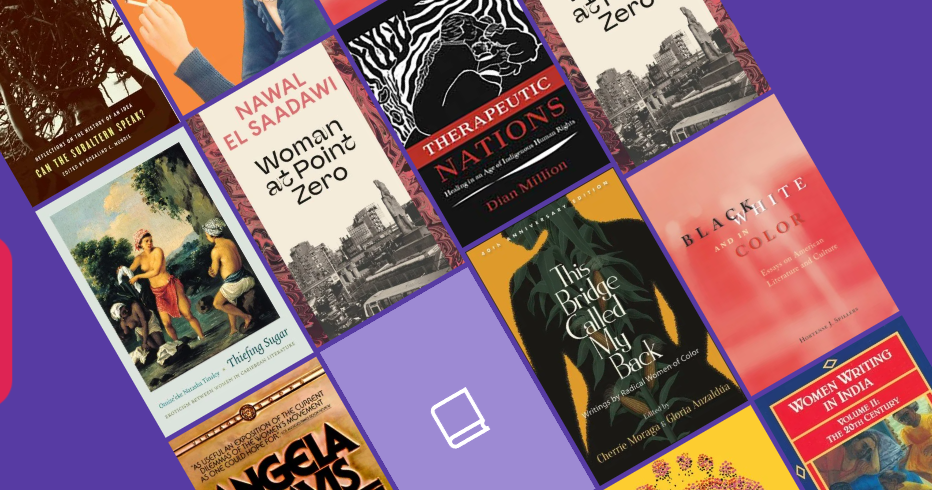
Cherríe Moraga and Gloria Anzaldúa, eds., This Bridge Called My Back
A landmark anthology of women of color feminist writing that changed the field by insisting on race, sexuality, class, and lived contradiction. -
Gloria Anzaldúa, Borderlands / La Frontera
A genre-defying classic on language, identity, mestizaje, and life at the border, both literal and psychic. -
Chela Sandoval, Methodology of the Oppressed
A demanding but generative theory text on oppositional consciousness, survival, and resistance within late twentieth-century power structures. -
María Lugones, Pilgrimages/Peregrinajes
A rich collection that explores coalition, world-traveling, decolonial feminism, and the complexity of crossing social worlds. -
Hortense J. Spillers, Black, White, and in Color
A brilliant, difficult collection that reshaped Black feminist literary and cultural criticism.
Transnational and Postcolonial Feminist Theory
-
Chandra Talpade Mohanty, Feminism without Borders
A powerful intervention against narrow Western feminism, arguing for solidarity grounded in history, labor, and anti-imperial critique. -
Kumari Jayawardena, Feminism and Nationalism in the Third World
A crucial study of how feminist struggles emerged within anti-colonial and nationalist movements across Asia and the Middle East. -
Gayatri Chakravorty Spivak, Can the Subaltern Speak?
A famous essay rather than a standard standalone book, this is a foundational critique of representation, power, and who gets heard. -
Silvia Federici, Caliban and the Witch
A sweeping feminist account of capitalism, enclosure, witch hunts, and the violent making of modern gendered labor. -
Sara Ahmed, Living a Feminist Life
A smart, widely read book that connects feminist theory to daily practice, institutional life, complaint, and survival.
African and Arab Feminist Thought
-
Oyèrónkẹ́ Oyěwùmí, The Invention of Women
A major challenge to Western assumptions about gender, using Yoruba society to rethink what gender means and how it gets imposed. -
Oyèrónkẹ́ Oyěwùmí, ed., African Gender Studies: A Reader
A useful collection for readers who want a broader grounding in African feminist and gender theory. -
Ifi Amadiume, Male Daughters, Female Husbands
A groundbreaking study of gender flexibility and kinship in Igbo society that unsettles rigid Western categories. -
Amina Mama, Beyond the Masks
A sharp analysis of race, gender, coloniality, and the psychic life of power in African contexts. -
Nawal El Saadawi, Woman at Point Zero
A searing short novel about gendered violence, class, and survival that remains widely taught and deeply unsettling. -
Nawal El Saadawi, The Hidden Face of Eve
A classic work of Arab feminist critique on patriarchy, religion, sexuality, and women’s lives. -
Fatema Mernissi, Beyond the Veil
A major text in Arab and Islamic feminist analysis, focused on gender, sexuality, and social structure.
Caribbean, Black Atlantic, and Decolonial Thought
-
Sylvia Wynter, On Being Human as Praxis
A demanding but transformative work that rethinks the human, colonialism, and knowledge itself. -
Omise’eke Natasha Tinsley, Thiefing Sugar
A brilliant study of eroticism, queer desire, and women’s writing in the Caribbean. -
Kaiama L. Glover, A Regarded Self
A sophisticated exploration of Caribbean womanhood, ethics, and literary self-making. -
Carla Freeman, High Tech and High Heels in the Global Economy
An important study of women, labor, class aspiration, and globalization in the Caribbean. -
Simone A. James Alexander, “Caribbean Feminist Criticism”
This is better understood as a chapter or essay than a standalone trade book, but it is a strong entry point into Caribbean feminist theorizing.
Indigenous Feminist and Decolonial Studies
-
Linda Tuhiwai Smith, Decolonizing Methodologies
One of the most influential books in Indigenous and decolonial scholarship, essential for rethinking research, knowledge, and power. -
Audra Simpson, Mohawk Interruptus
A major work on sovereignty, refusal, and Indigenous political life across settler borders. -
Aileen Moreton-Robinson, Talkin’ Up to the White Woman
A foundational Indigenous feminist critique of white feminism, possession, and settler power. -
Indigenous Women and Feminism
A key edited volume that brings together Indigenous feminist scholarship across politics, activism, and cultural analysis. -
Joanne Barker, ed., Critically Sovereign
A major collection on Indigenous gender, sexuality, sovereignty, and feminist studies. -
Dian Million, Felt Theory and related essays
More a body of essays than a single standard book title, this work is essential for understanding Indigenous affect, testimony, and theory.
South Asian and East Asian Gender and Modernity
-
Kumkum Sangari and Sudesh Vaid, eds., Recasting Women
A foundational collection on colonial history, reform, nationalism, and gender in South Asia. -
Susie Tharu and K. Lalita, eds., Women Writing in India
A major anthology that opens a vast archive of women’s writing across languages, periods, and forms. -
Rey Chow, Woman and Chinese Modernity
A sophisticated analysis of visuality, modernity, gender, and representation in Chinese cultural production.
This is not a finished canon. It is a reading path. Start with the primers, move slowly into theory, and let the books that unsettle you do their work.
If you purchase through the list, I may earn a small commission through Bookshop, which helps support my writing and curation.
Read more widely. Read more historically. Raise readers who can recognize power on sight.